You’re standing in front of your bathroom mirror wondering if your current skincare routine is actually working. Is that serum reducing your pores? Are those dark spots fading? You can’t really tell by looking, and your phone camera lies depending on the lighting.
What if your mirror could tell you exactly what’s happening with your skin, analyzing every pore, wrinkle, and spot in 30 seconds flat? That’s exactly what the Samsung AI beauty mirror unveiled at CES 2026 promises to do. This isn’t science fiction anymore. It’s sitting in Samsung’s booth right now, scanning faces and delivering personalized skin analysis powered by artificial intelligence.
The Samsung AI beauty mirror represents a major leap forward in at-home beauty technology. Developed in partnership with Amorepacific, one of Korea’s largest beauty companies, this smart mirror uses AI to detect pores, redness, pigmentation, and wrinkles faster and more accurately than manual inspection. In this article, you’ll discover how the Samsung AI beauty mirror works, what it analyzes, how it compares to other smart beauty devices like LED face masks, when you can buy it, and whether this AI-powered mirror is worth adding to your beauty tech arsenal.
Why the Samsung AI Beauty Mirror Announcement Matters
If you’ve been following beauty technology trends, you know we’re in the middle of a major shift. Skincare isn’t just about buying the right products anymore. It’s about understanding your skin at a deeper level and personalizing your routine based on actual data, not guesswork.
The Samsung AI beauty mirror announcement at CES 2026 signals where the industry is heading: intelligent, personalized, data-driven skincare. According to recent consumer research, 64% of U.S. consumers prefer personalized skincare products, and 46% are willing to pay more for solutions that make their routines more effective and easier to follow.
Traditional mirrors show you what you look like. Smart mirrors tell you what’s actually happening beneath the surface. The Samsung AI beauty mirror uses Amorepacific’s proprietary AI technology to analyze your skin in ways that weren’t possible with consumer devices until now. Think of it as having a dermatologist’s trained eye available 24/7 in your bathroom.
This matters because skincare is expensive and confusing. People spend hundreds of dollars on products that might not address their actual concerns. If you’re treating pigmentation when your real issue is dehydration, you’re wasting money and time. The Samsung AI beauty mirror aims to solve this by giving you objective, consistent analysis that tracks changes over time.
This growing demand for measurable results reflects a wider shift toward self-quantification. People are moving away from guesswork and looking for simple, trackable insights instead. The same idea shows up in tools like X IQ Checker, which uses AI to analyze social media behavior and highlight patterns in a more structured way. Whether it’s your skin or your digital presence, it’s all about understanding things a little more clearly over time.
What makes this announcement particularly significant is the partnership between Samsung (tech leader) and Amorepacific (K-beauty giant). Korean beauty brands have been at the forefront of skincare innovation for years, and combining that expertise with Samsung’s AI and display technology creates something genuinely new in the consumer beauty space.


How the Samsung AI Beauty Mirror Works
AI-Powered Skin Analysis Technology
The Samsung AI beauty mirror uses advanced computer vision and machine learning algorithms to analyze your face. When you stand in front of the mirror, built-in cameras capture high-resolution images of your skin from multiple angles. The AI processes these images in real-time, identifying and measuring various skin concerns.
Amorepacific developed the AI model by training it on thousands of facial images with professionally assessed skin conditions. The algorithm learned to recognize patterns associated with different skin issues: enlarged pores, hyperpigmentation, redness from inflammation, fine lines, wrinkles, and texture irregularities.
According to Samsung’s CES presentation, the Samsung AI beauty mirror completes this entire analysis in approximately 30 seconds. That’s significantly faster than professional skin analysis devices used in dermatology offices, which can take several minutes per scan and require a technician to operate them.
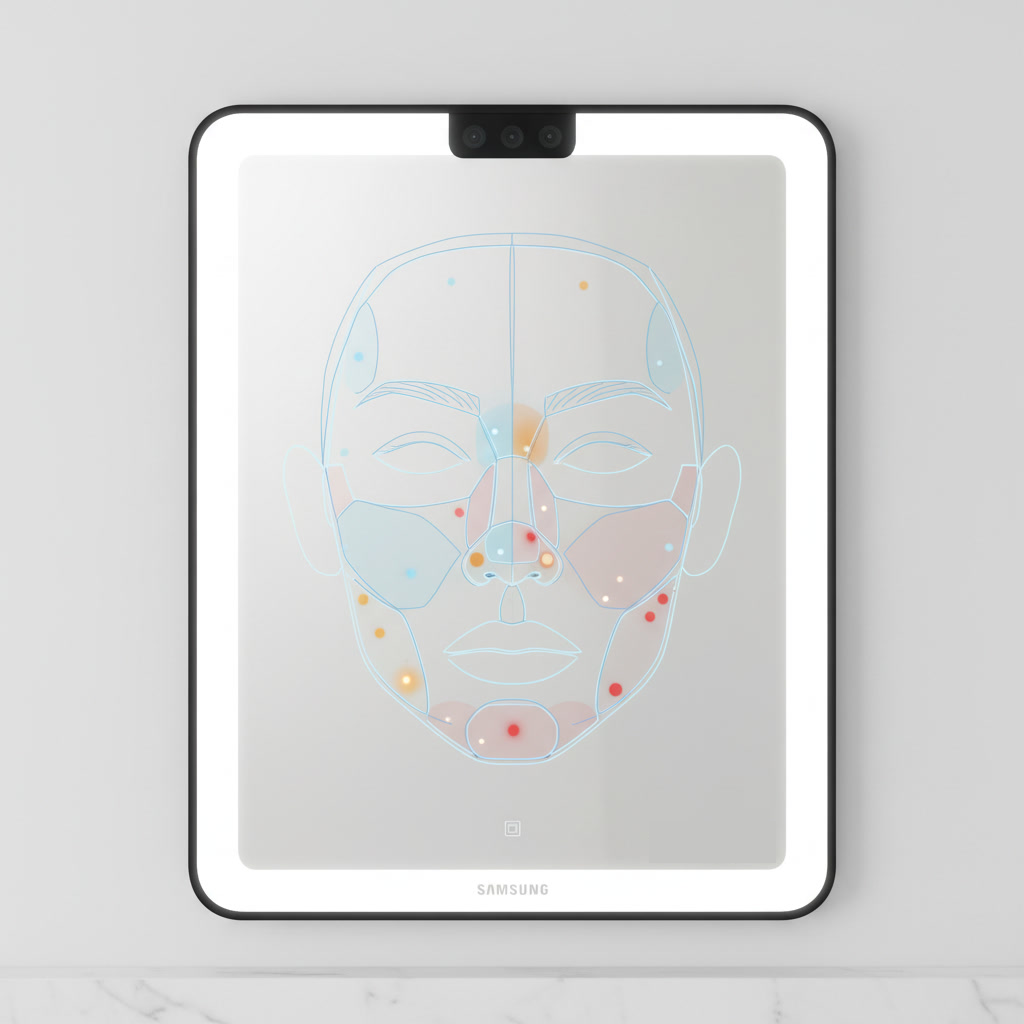
The mirror doesn’t just take a snapshot. It maps your face into zones and analyzes each area separately. Your T-zone might show different concerns than your cheeks or jaw area. This zoned approach provides more nuanced information than a general overall assessment.
What the Samsung AI Beauty Mirror Analyzes
Based on the CES 2026 demonstration, the Samsung AI beauty mirror evaluates several key skin metrics:
Pore Size and Distribution: The AI measures pore diameter and maps where enlarged pores are concentrated. This is particularly useful because pore size can indicate oil production issues, aging, or inadequate cleansing.
Redness and Inflammation: The system detects areas of redness that might indicate irritation, rosacea, or inflammatory conditions. It can differentiate between generalized redness and localized inflammation from breakouts.
Pigmentation Issues: The Samsung AI beauty mirror identifies dark spots, sun damage, melasma, and uneven skin tone. It can track whether pigmentation is improving or worsening over time with your current routine.
Wrinkles and Fine Lines: Using depth-detection technology, the mirror analyzes the depth and length of wrinkles around eyes, forehead, mouth, and other common aging areas. This is similar to how professional imaging systems work but automated for home use.
Skin Texture: The AI evaluates surface smoothness, detecting rough patches, bumpy areas, or texture inconsistencies that might not be immediately visible to the naked eye.
What’s particularly interesting is that the Samsung AI beauty mirror doesn’t just identify these issues. It quantifies them with specific measurements and scores, allowing you to track changes week by week or month by month.
Real-Time Feedback and Recommendations
After completing the 30-second analysis, the Samsung AI beauty mirror displays results directly on the mirror surface. You can see highlighted areas showing where specific concerns are concentrated. The interface reportedly uses color-coding and heat-map style visualizations to make data easy to understand at a glance.
The system then provides personalized skincare recommendations based on your analysis. If your AI scan shows dehydration and enlarged pores, it might suggest hydrating serums and products with niacinamide or retinol for pore refinement. These recommendations draw from Amorepacific’s extensive product database and skincare research.
However, Samsung hasn’t specified whether the recommendations are limited to Amorepacific brands or if the AI provides more general ingredient-based suggestions. This will be a key detail when the product launches.
Samsung AI Beauty Mirror vs Other Smart Beauty Devices
Comparison with LED Face Masks
You might be wondering how the Samsung AI beauty mirror relates to LED face masks, since both represent cutting-edge beauty technology. They’re actually complementary rather than competing devices.
LED face masks like the CurrentBody or TheraFace deliver treatment through light therapy. They use specific wavelengths (red, blue, near-infrared) to stimulate cellular processes that improve skin appearance. LED masks are active treatments that directly affect your skin.
The Samsung AI beauty mirror is diagnostic, not therapeutic. It tells you what’s wrong so you can choose the right treatments, whether that’s LED therapy, topical products, or professional procedures. Think of the mirror as the diagnostic tool and LED masks as one of many potential treatment options.
That said, the two devices work beautifully together. You could use the Samsung AI beauty mirror to track how your skin responds to LED therapy over time. Take a baseline scan before starting LED treatments, then scan weekly to see if wrinkles are diminishing, redness is reducing, or texture is improving. This objective data is far more reliable than subjective visual assessment.
Smart Mirrors vs Professional Skin Analysis
Professional skin analysis devices at dermatology offices or high-end spas use similar imaging technology but typically cost tens of thousands of dollars. The VISIA Complexion Analysis system, for example, is considered the gold standard and costs around $30,000-$50,000.
The Samsung AI beauty mirror brings similar capabilities to consumers at presumably a fraction of that cost. While professional systems might have higher resolution imaging or additional analysis features (like UV damage detection), the Samsung mirror should be adequate for tracking common concerns and monitoring skincare effectiveness at home.
Professional analysis typically requires appointments, travel time, and fees of $100-$300 per session. Having a Samsung AI beauty mirror at home means you can check your skin as often as you want without scheduling or cost barriers. For people serious about skincare optimization, this convenience factor is huge.
Samsung Mirror vs Other Smart Beauty Tech
The beauty tech market has exploded with various smart devices: facial cleansing brushes with app connectivity, LED therapy wands, microcurrent devices, and more. The Samsung AI beauty mirror occupies a unique niche as an analysis and tracking tool rather than a treatment device.
It’s most comparable to smartphone apps that analyze skin through your camera (like those from brands like Neutrogena or La Roche-Posay). However, a dedicated mirror with purpose-built cameras and Samsung’s display technology should provide more accurate and consistent analysis than phone-based solutions, which vary dramatically depending on lighting and camera quality.
The integration with Amorepacific’s AI also gives the Samsung AI beauty mirror an advantage. Amorepacific has been developing AI skincare analysis for years and has access to extensive skin data from Korean consumers, where skincare routines are more elaborate and documentation is more common.
The Technology Behind Samsung’s AI Mirror

Computer Vision and Machine Learning
The Samsung AI beauty mirror relies on computer vision, a field of AI that teaches computers to interpret visual information. The mirror’s cameras capture detailed facial images, and the AI model analyzes these images pixel by pixel, looking for patterns it was trained to recognize.
Machine learning means the system was “taught” by showing it thousands of examples of different skin conditions. Engineers fed the AI images of pores (various sizes), wrinkles (various depths), pigmentation (various intensities), and redness (various causes), along with expert labels identifying each condition. Over time, the algorithm learned to recognize these patterns independently.
What makes Amorepacific’s AI particularly valuable is the quality and quantity of training data. Korean beauty culture emphasizes detailed skin analysis and regular professional assessments. Amorepacific could access a rich dataset of professionally evaluated skin images to train their algorithm, potentially making it more accurate for Asian skin types but also well-rounded for diverse populations.
Display Technology and User Interface
Samsung is, of course, a leader in display technology. The Samsung AI beauty mirror likely uses a two-way mirror with embedded display technology, similar to Samsung’s smart mirror products for retail environments. You see your reflection normally, but the mirror can overlay digital information when needed.
The interface must balance showing you your reflection with displaying analysis results. Based on CES demonstrations, it appears the Samsung AI beauty mirror can switch between modes: pure mirror mode for makeup application or normal use, and analysis mode where skin zones are highlighted and data is displayed.
The 30-second analysis speed suggests significant processing power built into the device. Image processing, AI inference, and result visualization all happen locally rather than relying on cloud processing, which means faster results and better privacy for your facial data.
Privacy and Data Security
Speaking of privacy, facial data and skin analysis information are highly personal. Samsung hasn’t released detailed privacy policies for the Samsung AI beauty mirror yet, but this will be crucial information before purchase.
Key questions include: Where is your skin data stored (locally on device, Samsung cloud, Amorepacific servers)? Who has access to it? Can it be used for marketing or product development? Can you delete your data completely?
Given increasing consumer awareness about data privacy, Samsung will need to address these concerns transparently. The ideal scenario would be local storage with optional cloud backup that you control, similar to how health data is handled on smartphones.
Expected Features and Specifications
While Samsung hasn’t released complete technical specifications for the Samsung AI beauty mirror, we can make educated assumptions based on the CES presentation and similar products:
Mirror Size and Design
The Samsung AI beauty mirror will likely come in multiple sizes to suit different bathrooms and vanity setups. Expect options ranging from compact personal mirrors (12-15 inches) to larger vanity mirrors (24-30 inches). The housing will probably be sleek and modern, matching Samsung’s design aesthetic across their smart home products.
The mirror needs to be mounted or positioned at an appropriate height and angle for facial analysis, so flexible mounting options (wall-mount, countertop stand, adjustable arm) would make sense.
Camera and Imaging Specifications
Multiple high-resolution cameras will be embedded discreetly around the mirror frame or behind the glass. These cameras need sufficient megapixel count to capture fine skin details like individual pores and shallow wrinkles. Expect at least 12-16 megapixel sensors, possibly higher.
Lighting is critical for consistent analysis. The Samsung AI beauty mirror will probably include calibrated LED lighting around the mirror perimeter that provides even, neutral illumination. This ensures your skin is analyzed under the same conditions every time, eliminating variables that could skew results.
Connectivity and App Integration
Smart mirrors require connectivity for software updates, data syncing, and potentially cloud features. The Samsung AI beauty mirror will almost certainly include WiFi connectivity and likely Bluetooth as well.
A companion smartphone app seems inevitable. You’d use the app to review historical analysis data, track progress over time with charts and graphs, receive skincare recommendations, and potentially integrate with other health and beauty tracking apps.
Samsung might integrate the mirror with their SmartThings ecosystem, allowing it to work with other Samsung smart home devices. Imagine your mirror analyzing your skin in the morning and automatically adjusting your smart lighting or recommending a humidifier level adjustment if it detects dryness.
Power and Installation
Unlike portable beauty devices, a mirror is typically a permanent bathroom fixture. The Samsung AI beauty mirror will likely require AC power rather than battery operation, given the processing power needed for AI analysis and the always-on display.
Installation complexity will be a key purchasing consideration. If it requires professional electrical work, that adds cost and hassle. If it plugs into a standard outlet and mounts with adhesive or simple hardware, adoption will be easier.


When Can You Buy the Samsung AI Beauty Mirror?
CES 2026 Announcement vs Market Availability
Samsung unveiled the Samsung AI beauty mirror at CES 2026 (January 6-9, 2026), but CES announcements don’t always mean immediate availability. Consumer electronics companies often showcase products at CES that won’t ship for 6-18 months.
Based on typical Samsung product timelines and the apparent readiness of the technology demonstrated at CES, we can estimate a launch sometime in late 2026 or early 2027. Samsung might launch in South Korea first (their home market and where Amorepacific is based), then expand to other regions.
For context, when Samsung launches beauty or wellness tech, they often test in Asian markets first where consumer adoption of beauty technology is higher, then expand to North America and Europe once they’ve refined the product based on initial feedback.
Expected Pricing
Samsung hasn’t announced pricing for the Samsung AI beauty mirror, but we can estimate based on comparable technology and Samsung’s typical pricing strategy.
Professional skin analysis mirrors cost $30,000-$50,000, obviously not a consumer price point. Smart mirrors for retail or hospitality run $2,000-$5,000 but lack the sophisticated AI analysis.
Consumer beauty devices with AI features (like some high-end facial cleansing systems or LED masks) typically retail for $200-$600. Given the Samsung AI beauty mirror includes display technology, multiple cameras, advanced AI processing, and Samsung/Amorepacific branding, expect pricing at the higher end of consumer beauty tech.
Realistic estimate: $500-$1,200 depending on size and features. A compact personal mirror might start around $500-$700, while a larger vanity mirror with more advanced features could reach $1,000-$1,200.
That’s a significant investment, comparable to a high-end LED face mask or professional skincare treatment package. Whether it’s worth it depends on how seriously you take skincare optimization and whether you value data-driven decisions.
Where It Will Be Sold
The Samsung AI beauty mirror will likely be available through:
- Samsung’s Official Website and Stores: Direct purchase with full support and warranty
- Major Electronics Retailers: Best Buy, or similar electronics chains that carry Samsung smart home products
- Premium Beauty Retailers: Possibly Sephora or Ulta if Samsung positions this as beauty tech rather than general electronics
- Online Marketplaces: Amazon, though possibly not at initial launch
Distribution strategy will reveal Samsung’s target market. If they sell primarily through beauty retailers, they’re targeting skincare enthusiasts. If they focus on electronics channels, they’re positioning it as smart home technology.
Who Should Consider the Samsung AI Beauty Mirror?
Skincare Enthusiasts Who Track Results
If you’re someone who tries multiple products and wants objective data on what’s actually working, the Samsung AI beauty mirror could be invaluable. Instead of guessing whether that new retinol serum is reducing wrinkles, you’d have measurable data showing improvement (or lack thereof) over time.
This is similar to how fitness enthusiasts use scales, body composition analyzers, and fitness trackers to monitor progress. The Samsung AI beauty mirror brings that same data-driven approach to skincare.
People with Specific Skin Concerns
If you’re dealing with persistent issues like rosacea, hyperpigmentation, or acne, tracking changes becomes even more important. The Samsung AI beauty mirror could help you identify triggers (did your redness worsen after trying a new product?) and monitor whether treatments are effective.
For conditions that change slowly over months, human visual assessment is unreliable. Having consistent, quantified measurements removes doubt and helps you stay patient with treatments that work slowly but steadily.
Beauty Tech Early Adopters
If you already own LED face masks, microcurrent devices, or other smart beauty tools, the Samsung AI beauty mirror fits naturally into your routine. You can use it to track how your various treatments are performing and make data-based decisions about which devices and products to continue using.
The mirror becomes the central hub for all your beauty technology, providing the metrics you need to optimize everything else.
Those Who Value Personalization
Generic skincare recommendations don’t work for everyone. The Samsung AI beauty mirror promises personalized analysis and suggestions based on your actual skin condition. If you’ve struggled to find products that work because off-the-shelf recommendations don’t match your needs, AI-driven personalization could be the solution.
People It’s Probably Not For
The Samsung AI beauty mirror likely isn’t necessary if you have relatively clear, problem-free skin and a simple routine that already works well. The insights might be interesting, but you probably won’t change your behavior based on the data.
It’s also not ideal if you’re looking for a treatment device rather than diagnostic tool. The mirror won’t improve your skin by itself; it only tells you what needs improvement. You’ll still need to invest in appropriate treatments.
Budget-conscious consumers might struggle to justify the estimated $500-$1,200 price when that money could buy several months of effective skincare products or multiple LED therapy sessions.
Samsung AI Beauty Mirror and the Future of Personalized Skincare
The Samsung AI beauty mirror represents a broader trend toward personalized, data-driven beauty. We’re moving away from one-size-fits-all products and toward customized solutions based on individual needs.
Integration with Smart Skincare Ecosystems
Imagine a future where your Samsung AI beauty mirror doesn’t work in isolation. It could connect with smart skincare dispensers that customize formulations based on your morning skin scan. If your mirror detects dryness, your dispenser adjusts today’s moisturizer to include extra hyaluronic acid. If redness increases, it adds more soothing ingredients.
Companies like Proven and Curology already offer personalized skincare based on questionnaires and photos. The Samsung AI beauty mirror could eliminate the questionnaire step and provide daily rather than one-time customization.
AI That Learns Your Skin Over Time
First-generation AI analysis will be impressive, but future versions of the Samsung AI beauty mirror could become even more powerful. The mirror could learn your specific skin patterns: how you react to different ingredients, how seasonal changes affect you, even how sleep or stress correlate with skin condition.
Over months and years of data collection, the AI could make predictions: “Based on your patterns, your skin typically gets drier in two weeks when fall begins. Consider adding a heavier moisturizer now to prevent that.”
Professional-Grade Insights at Home
The gap between professional dermatology tools and consumer devices keeps shrinking. The Samsung AI beauty mirror accelerates this trend. In five years, the difference between a $50,000 professional analysis system and a $1,000 consumer mirror might be minimal for common skincare concerns.
This democratizes access to skin health information. You don’t need to live near a dermatology office or afford expensive appointments to track your skin professionally.
Frequently Asked Questions
How much does the Samsung AI beauty mirror cost?
Samsung hasn’t announced official pricing for the Samsung AI beauty mirror yet. Based on comparable smart home technology and beauty devices, experts estimate it will cost between $500-$1,200 depending on size and features. A compact personal mirror might start around $500-$700, while larger vanity models with advanced features could reach $1,000-$1,200. Official pricing will be revealed closer to the launch date in late 2026 or early 2027.
When will the Samsung AI beauty mirror be available to buy?
The Samsung AI beauty mirror was announced at CES 2026 (January 6-9) but doesn’t have a confirmed release date. Based on typical product development timelines for CES announcements, expect availability in late 2026 or early 2027. Samsung will likely launch first in South Korea, then expand internationally. Sign up for notifications on Samsung’s official website to be alerted when pre-orders begin.
Does the Samsung AI beauty mirror actually work for skin analysis?
The Samsung AI beauty mirror uses Amorepacific’s AI technology trained on thousands of professionally assessed facial images. The system can detect pores, redness, pigmentation, and wrinkles in 30 seconds using computer vision and machine learning. While it should be accurate for common skin concerns, it’s not a substitute for professional dermatological diagnosis of medical conditions. The mirror is best used for tracking skincare routine effectiveness and monitoring changes over time.
Can the Samsung AI beauty mirror replace visits to a dermatologist?
No, the Samsung AI beauty mirror cannot replace professional dermatological care. While it can track common cosmetic concerns like wrinkles, pores, and pigmentation, dermatologists diagnose and treat medical skin conditions, suspicious lesions, and prescribe medications. Think of the mirror as a wellness tracking tool (like a fitness tracker for your skin) rather than medical diagnostic equipment. Always consult a dermatologist for concerning skin changes or conditions.
Is the Samsung AI beauty mirror compatible with LED face masks?
The Samsung AI beauty mirror and LED face masks serve complementary purposes. The mirror provides diagnostic analysis (identifying skin concerns), while LED masks provide treatment (improving skin through light therapy). You can use them together effectively: scan your skin with the Samsung AI beauty mirror to establish a baseline, undergo LED therapy treatments, then scan again weeks later to measure improvement. The mirror helps track whether your LED mask is delivering results.
Does the Samsung AI beauty mirror store my facial data?
Samsung hasn’t released complete privacy details for the Samsung AI beauty mirror yet. Key questions to ask before purchase include where data is stored (locally on the device, Samsung cloud, or Amorepacific servers), who has access to your facial scans and skin analysis, whether data can be used for marketing, and if you can delete all your information. Request Samsung’s privacy policy when the product launches to understand exactly how your personal data is handled.
How does the Samsung AI beauty mirror compare to smartphone skin analysis apps?
The Samsung AI beauty mirror should provide more accurate and consistent analysis than smartphone apps for several reasons: dedicated high-resolution cameras designed specifically for skin imaging (versus general-purpose phone cameras), controlled lighting that ensures consistent conditions for every scan (versus variable lighting with phones), larger display for viewing results in detail, and Amorepacific’s professional-grade AI trained on extensive skin analysis data. Phone apps are convenient but variable; the mirror should deliver professional-quality consistency.
The Bottom Line on Samsung’s AI Beauty Mirror
The Samsung AI beauty mirror represents a significant step forward in at-home beauty technology. By bringing professional-grade skin analysis into your bathroom, it democratizes access to the kind of objective, detailed skin assessment that previously required expensive dermatology visits.
The partnership between Samsung’s display and AI technology and Amorepacific’s skincare expertise creates something genuinely useful: a tool that tells you what’s actually happening with your skin, tracks changes over time, and helps you make informed decisions about products and treatments.
However, it’s important to have realistic expectations. The Samsung AI beauty mirror is diagnostic, not therapeutic. It won’t improve your skin by itself. You’ll still need effective products, possibly professional treatments, and devices like LED face masks to address the concerns the mirror identifies.
Think of it as the foundation of a data-driven skincare routine. Just as fitness trackers revolutionized how people approach exercise and health by providing objective data, the Samsung AI beauty mirror could do the same for skincare. Instead of guessing whether your routine is working, you’ll know with measurable certainty.
For beauty tech enthusiasts who already invest in LED therapy devices, microcurrent tools, and premium skincare products, the Samsung AI beauty mirror is a logical addition that ties everything together. For people just starting to explore smart beauty devices, it might make more sense to begin with treatment tools like LED masks and add the analytical mirror later.
Watch for updates on pricing, availability, and full specifications as we approach the expected late 2026 or early 2027 launch. Check back at GlowMaskHub for hands-on reviews and detailed comparisons once the Samsung AI beauty mirror becomes available. The future of personalized skincare is looking clearer, and it’s staring right back at you from your mirror.